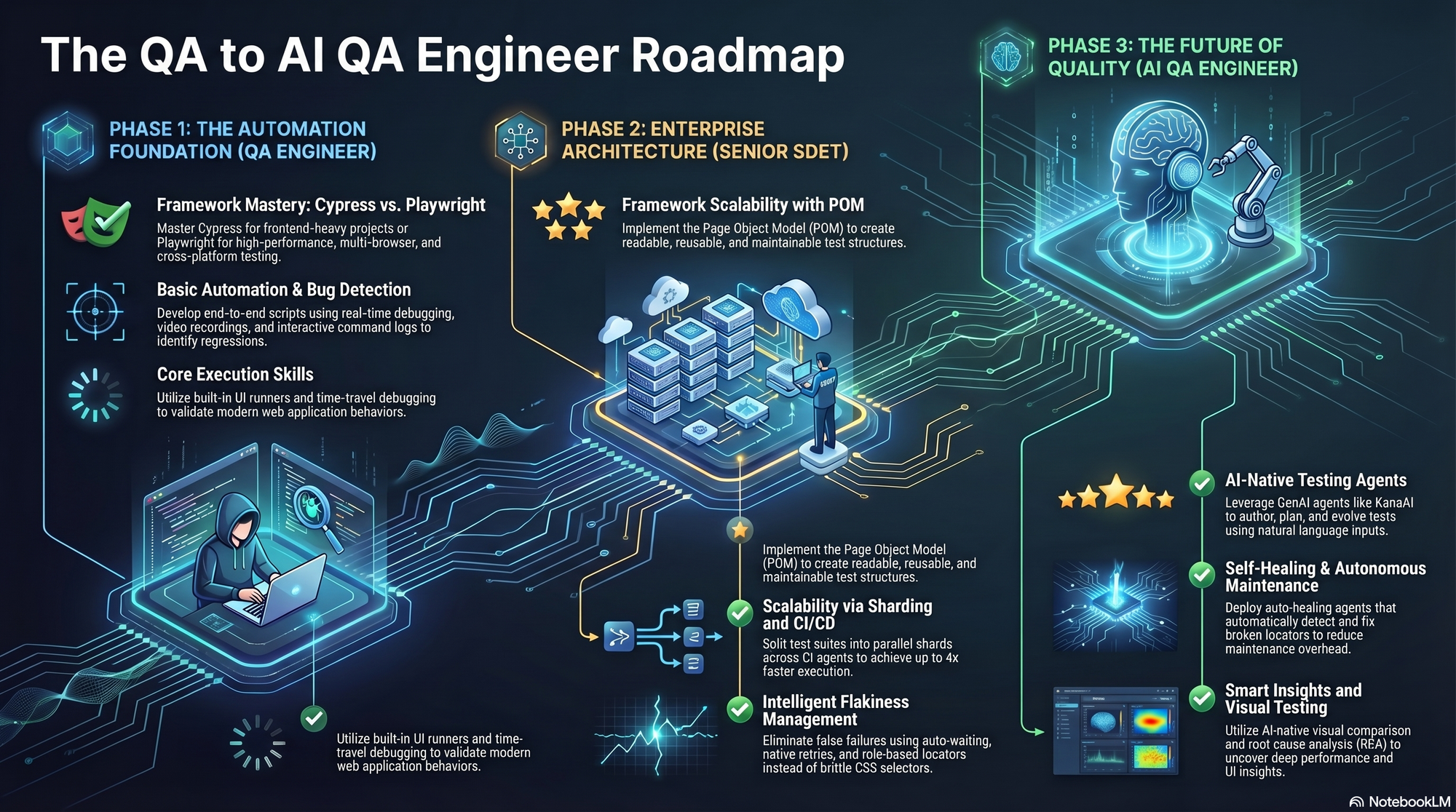
The Evolution of Quality Engineering: A Roadmap from QA to AI QA Engineer
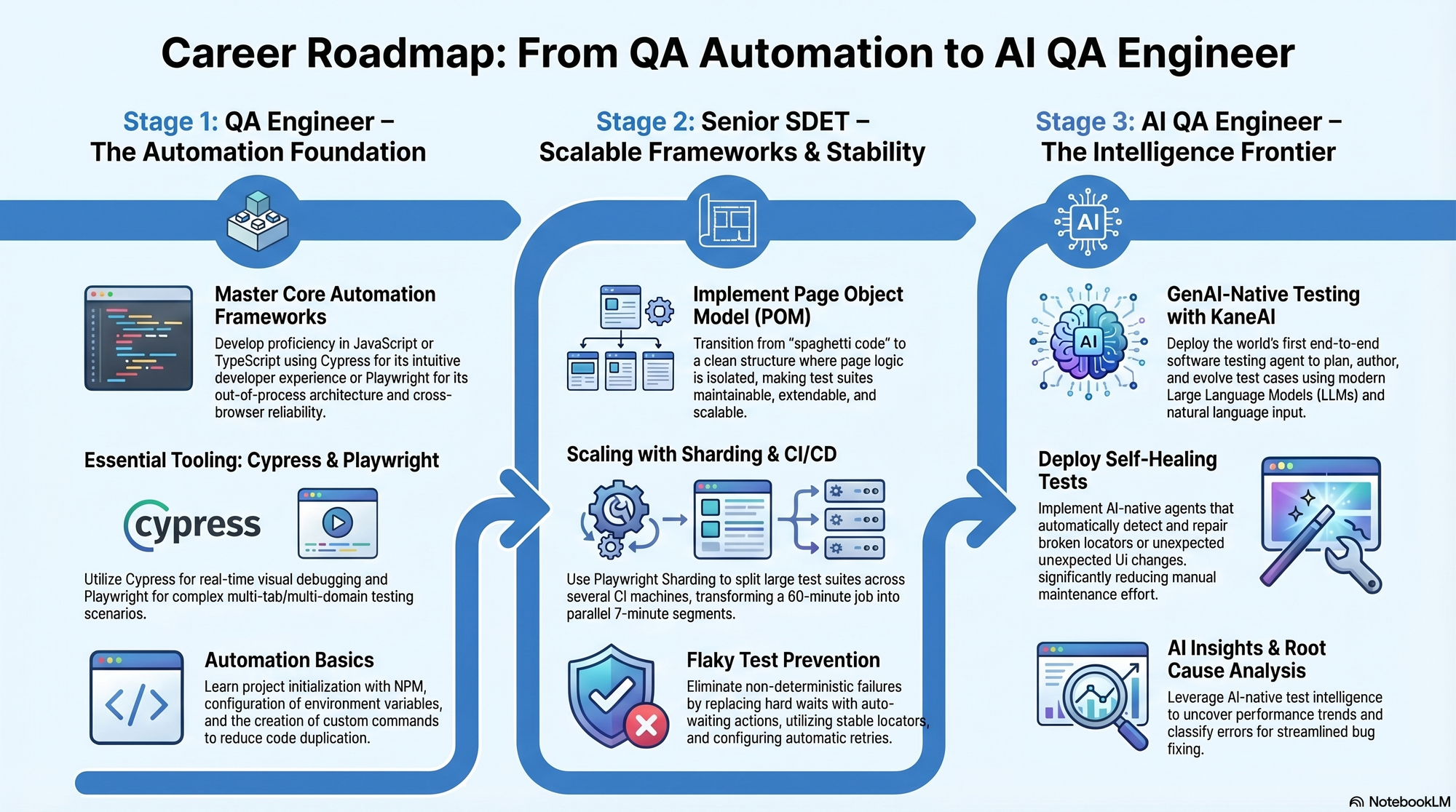
The landscape of software quality has undergone a seismic shift, evolving from manual verification and basic scripting into a high-stakes era of agentic automation. A defining moment in this transition occurred in mid-2024, when Playwright officially surpassed Cypress in weekly npm downloads. As of early 2026, Playwright has solidified its dominance, consistently reaching 20 to 30 million weekly downloads.This is not merely a change in tooling; it is an architectural and strategic pivot. To remain relevant in this new reality, Quality Engineers must navigate a specific career trajectory—moving from framework mastery to architectural ownership, and finally to AI-driven orchestration.
Phase 1: The QA Engineer Building the Automation Foundation
The first stage of the roadmap is about survival through execution. At this level, the primary goal is aligning your automation strategy with the tech stack. Choosing the wrong framework here isn't just a technical preference; it’s a commitment to specific architectural constraints.
The Framework Decision: Cypress vs. Playwright
While both frameworks aim to simplify end-to-end testing, their underlying DNA creates distinct trade-offs in scalability and resource management.
Vector | Cypress | Playwright |
|---|---|---|
Execution Model | In-process: Runs inside the browser loop, giving native DOM access. | Out-of-process: Communicates via WebSocket (DevTools Protocol). |
Browser Support | Chromium, Firefox (No native Safari/WebKit). | Chromium, Firefox, WebKit (Safari). |
Parallelization | Managed; requires paid Cypress Cloud for enterprise scaling. | Free, native parallelization across workers and machines. |
Stability | Relies on a command queue; prone to memory leaks at scale. | Native async/await with event-driven auto-waiting. |
When to Choose Cypress
Cypress remains a powerful choice for frontend-heavy projects and Single Page Applications (SPAs). Its "batteries-included" approach and visual debugging GUI are excellent for rapid iteration. However, Senior Architects should be wary: because it runs in-process, Cypress is susceptible to memory exhaustion. Real-world data from the field shows Cypress often crashing with memory errors once a suite exceeds approximately 120 tests in a single run.
When to Choose Playwright
Playwright is the industry standard for enterprise-level scalability. It is the only viable choice for teams requiring Safari or WebKit testing that Cypress simply cannot cover. Its out-of-process architecture makes it virtually immune to the memory overhead that plagues in-browser runners, making it the preferred engine for complex, multi-domain workflows and mixed-language stacks (Python, Java, C#).
Phase 2: The Senior SDET — Reliability and Architecture at Scale
The Transition Trigger: You move to Phase 2 when your suite hits 500+ tests and CI costs begin to spike, or when "flaky hell" starts blocking the delivery pipeline.At this stage, your job is to protect the budget and the pipeline. You aren't just writing scripts; you are building a professional-grade test architecture.Core Architectural Patterns: POM vs. App ActionsA Senior SDET must choose the right abstraction.
- Page Object Model (POM): The standard for decoupled, maintainable code. It treats the UI as a set of services.
- App Actions: Often used in Cypress to bypass the UI and set application state directly (e.g., via Redux). While faster for setting state, App Actions lack the architectural decoupling required for cross-framework scalability.
Realistic POM Implementation (Playwright/TypeScript):
export class LoginPage {
  readonly page: Page;
  readonly usernameInput = this.page.getByLabel('username');
  readonly loginButton = this.page.getByRole('button', { name: 'Sign in' });

  constructor(page: Page) { this.page = page; }

  async login(user: string, pass: string) {
    await this.usernameInput.fill(user);
    await this.page.getByLabel('password').fill(pass);
    await this.loginButton.click();
  }
}
Solving the Flakiness Crisis: The Reliability Rules
Test instability is the silent killer of QA trust. Data indicates that Playwright tests average a 0.72% flakiness rate compared to 0.83% in Cypress. To minimize this, follow these rules:
- Strict Locator Policy: Use user-facing locators (roles, text, labels) instead of brittle CSS or XPath selectors.
- Banish Hard Waits: Never use
waitForTimeout. Use Playwright’s auto-waiting actions that align with actual browser rendering events. - Mandatory Test Isolation: Reset state before each test. Shared data is a leading cause of side-effect failures.
Scaling and Cost EfficiencyFor teams running 1,000+ tests, efficiency is a financial metric. Playwright utilizes "Sharding" to natively distribute tests across machines for free. This architectural advantage allows for a 40% to 60% reduction in CI time compared to single-threaded Cypress execution, which typically requires a paid Cypress Cloud subscription (potentially exceeding $30,000/year at enterprise scale) to achieve similar parallel throughput.
Phase 3: The AI QA Engineer — Embracing Agentic Testing
The Transition Trigger: You move to Phase 3 when maintenance (fixing locators and updating scripts) consumes more than 30% of your sprint.This phase is defined by moving from manual scripting to AI orchestration, where the engineer manages a fleet of specialized agents.
Natural Language Test Creation with KaneAI
KaneAI is the industry's first GenAI-native end-to-end testing agent. It allows engineers to plan, author, and evolve tests using natural language. Instead of manually mapping every interaction, you provide the intent, and the agent constructs the execution logic.
Specialized AI Agents for 2026
An AI QA Engineer utilizes a multi-agent pipeline to handle the labor-intensive parts of the SDLC:
- Auto-Healing Agent: Overcomes flaky tests by automatically re-mapping locators when the UI changes.
- Root Cause Analysis (RCA) Agent: Strips away the manual labor of diagnosing failures by classifying errors (e.g., "Environment Down" vs. "Regressional Bug") instantly.
- Accessibility Testing Agent: Ensures 2026 compliance standards are met by auditing WCAG requirements autonomously.
- Visual Testing Agent: Detects regressions via AI-native image comparison that traditional assertions miss.
- Test Orchestration Agent: Dynamically optimizes test distribution and execution workflows based on real-time CI feedback.
Summary Table: The Three-Tier Career Roadmap
Phase | Primary Skillset | Key Tools | Core Objective |
|---|---|---|---|
QA Engineer | Scripting & Framework Alignment | Cypress, Playwright, Git | Establish foundational automation stability. |
Senior SDET | Architecture & CI/CD Optimization | Sharding, POM, GitHub Actions | Protect the pipeline and scale efficiency. |
AI QA Engineer | Natural Language Prompting & Agentic Orchestration | KaneAI, Self-Healing Agents, LLMs | Leverage AI to eliminate maintenance debt. |
Conclusion: The "More Dangerous" QA
The evolution from a traditional tester to an AI QA Engineer does not render the human element obsolete; it amplifies it. While AI can author scripts in seconds and heal broken locators, it lacks the context of the user journey.Manual QA remains irreplaceable for fresh features under rapid iteration, animation-heavy flows, and high-judgment edge cases. The true master of the craft knows when to automate and when to rely on their own eyes.By mastering these tools, you become a "more dangerous QA." You are the engineer who "tests what people assume works and breaks what AI insists is fine." You no longer struggle in the "flaky hell" of broken pipelines—you orchestrate a system that provides high-velocity, actionable intelligence to the business. The roadmap is clear. It is time to evolve.